

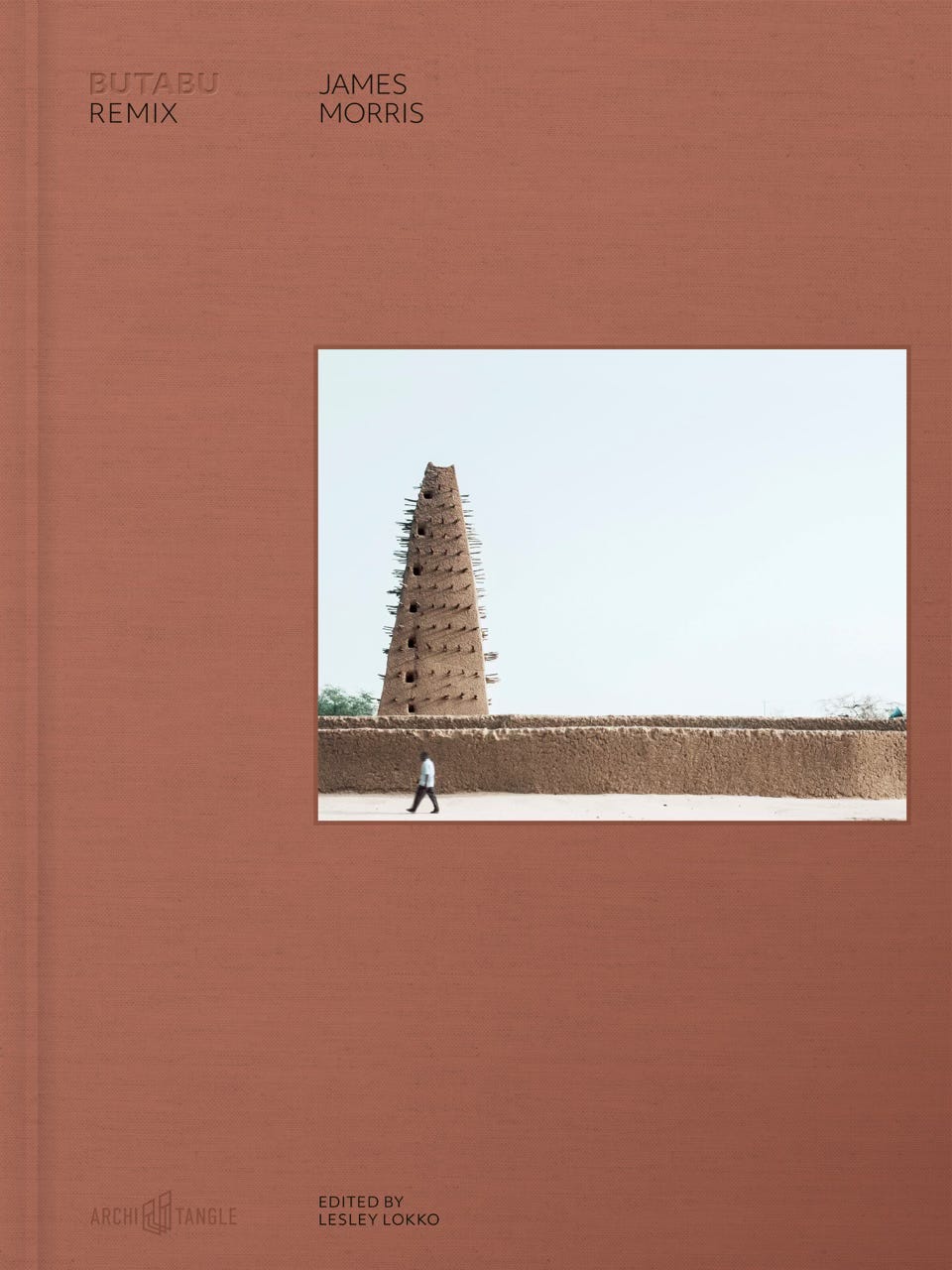
Butabu Remix
Reinterpreting a seminal work through a new lens

This week’s offering is a guest post from my friend the photographer, James Morris. In a thoughtful and personal essay, he discusses why he chose to revisit his landmark book about adobe architecture in West Africa in order to showcase writings from a new generation of African and diaspora architects, and to incorporate previously unseen images from his archive.
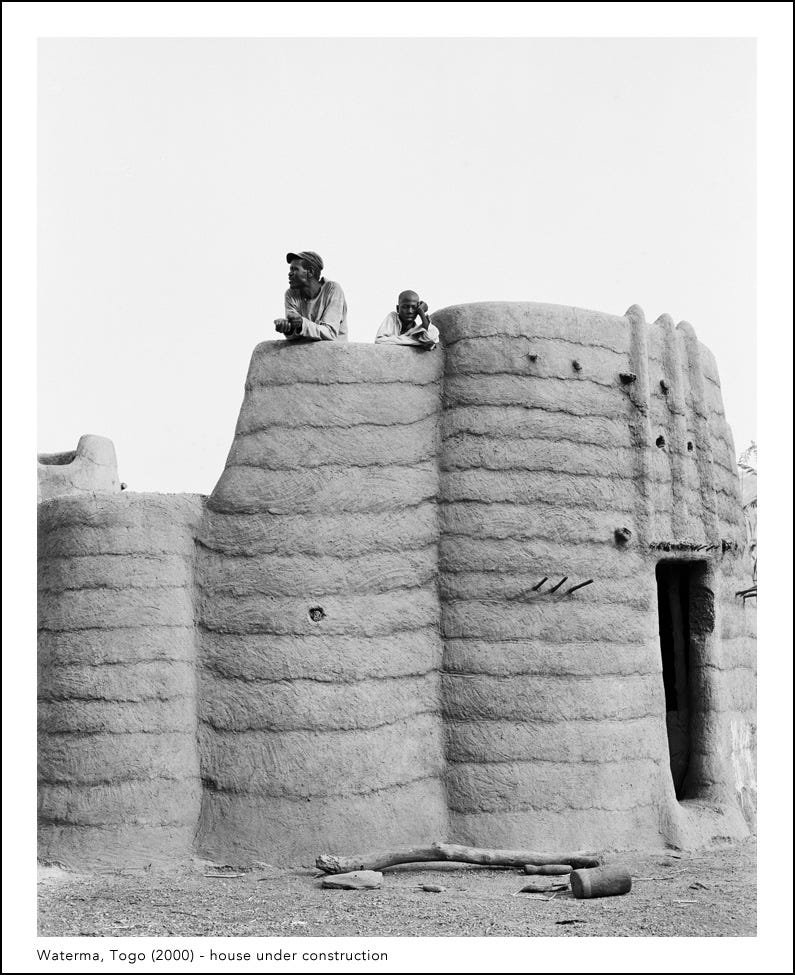
The word ‘butabu’ in the language of the Batammaliba people, whose lands span the northern borders of Togo and Benin, refers to the mixing of mud and water for the purpose of construction. The name ‘Batammaliba’ translates roughly as ‘those who are the architects of earth/mud’. The homes or compounds that they traditionally built are small fortresses that evolved in the times when slave raiders would come inland with the malicious intent of feeding their transatlantic trade it’s human cargo. Each property with in a village stands strategically a shot arrow’s distance apart. In times of threat the door could be barred and the extended family retreat to the roof top battlement where, with granaries built into the structure, they could withhold a siege for as long as might be necessary. As their aptronym might imply, Batammaliba structures go beyond the purely functional; they can be read like texts that communicate belief systems, status and traditions - they are expressions of the culture of their makers. Most striking perhaps is their individual form, no other buildings look quite like them, anywhere.
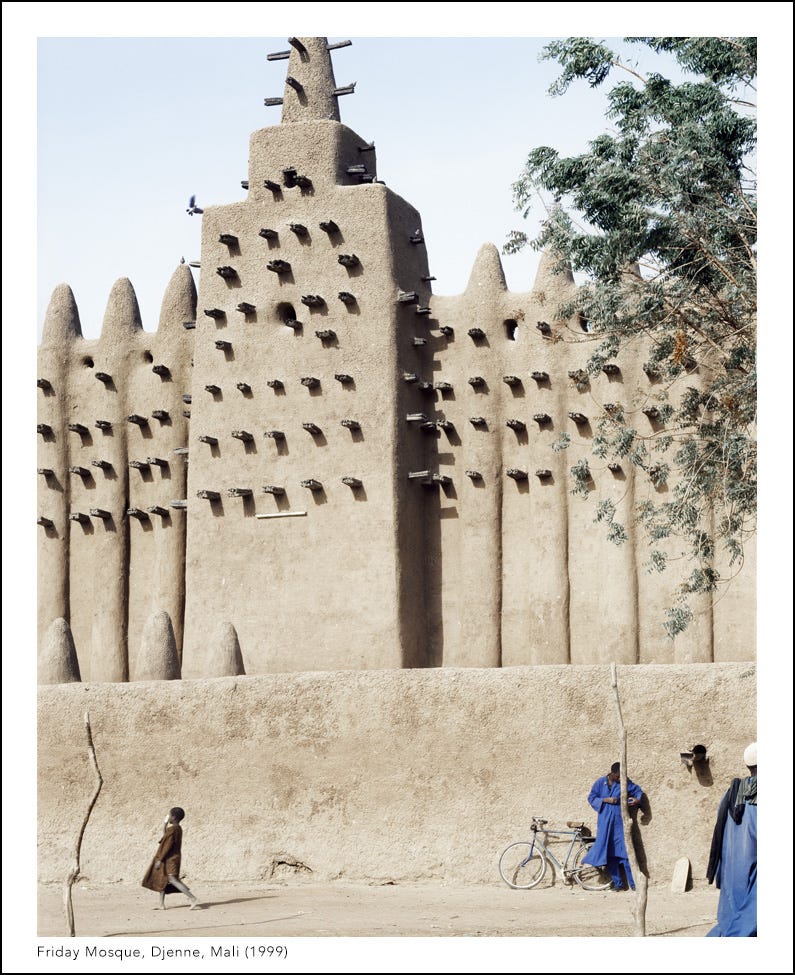
My curiosity for mud built architecture was sparked in the early 1990’s by the work of The Egyptian architect Hassan Fathy who saw he could learn from the still standing Pharaonic vaulted mud brick granaries of the Rammesseum at Thebes to build functional yet aesthetic, cost effective, climatically sensitive, low cost housing using available (free) materials (mud). Looking beyond Egypt, my inquiry led to the rich architectural landscape of the Sahel region of West Africa. At the time, in Britain especially, this building culture was not well known or widely appreciated, and the pictures I could find were largely the snaps of anthropologists and some romantics. My work as a photographer, and my more specific discipline of addressing the built environment, led to the idea of making a more extensive documentation of these landscapes. My interest was to approach these buildings photographically as I might built landscapes anywhere in the world, with method and contemplation; my hope was to acquire knowledge, and to be able to communicate it expressively.
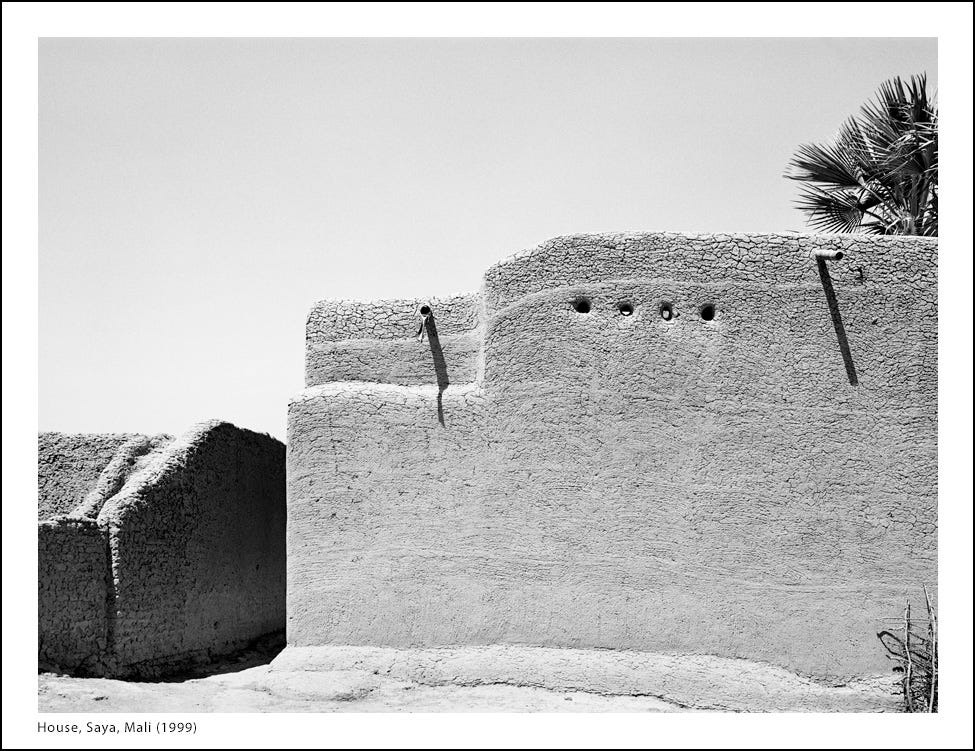
I made two journey’s to West Africa in 1999 and 2000. My equipment was both the architectural photographers stock in trade tripod mounted plate camera, adapted to use roll film, through which you see the world upside down and back to front - head under a dark cloth; and a 35mm handheld Nikon. For both expressive and practical reasons each picture on the large camera was taken in both colour and black and white.
I worked throughout with a talented Malian assistant I met in Bamako, who skillfully communicated our purpose along the way, drawing in the interest and help of people we met. The geographical area I set myself were those parts of west Africa where it rains very little, largely the Sahel region; as it seemed to me that when relieved of the need to keep people dry, the builders acquired the freedom to push materials to their creative limit, introducing sculptural form and innovations with light, shadow and texture more interestingly and daringly than comparable others had achieved; thus contributing greatly to the striking identities of this architecture. To complete the work we travelled through Mali, Niger, Nigeria, Togo, Benin, Ghana and Burkina Faso.
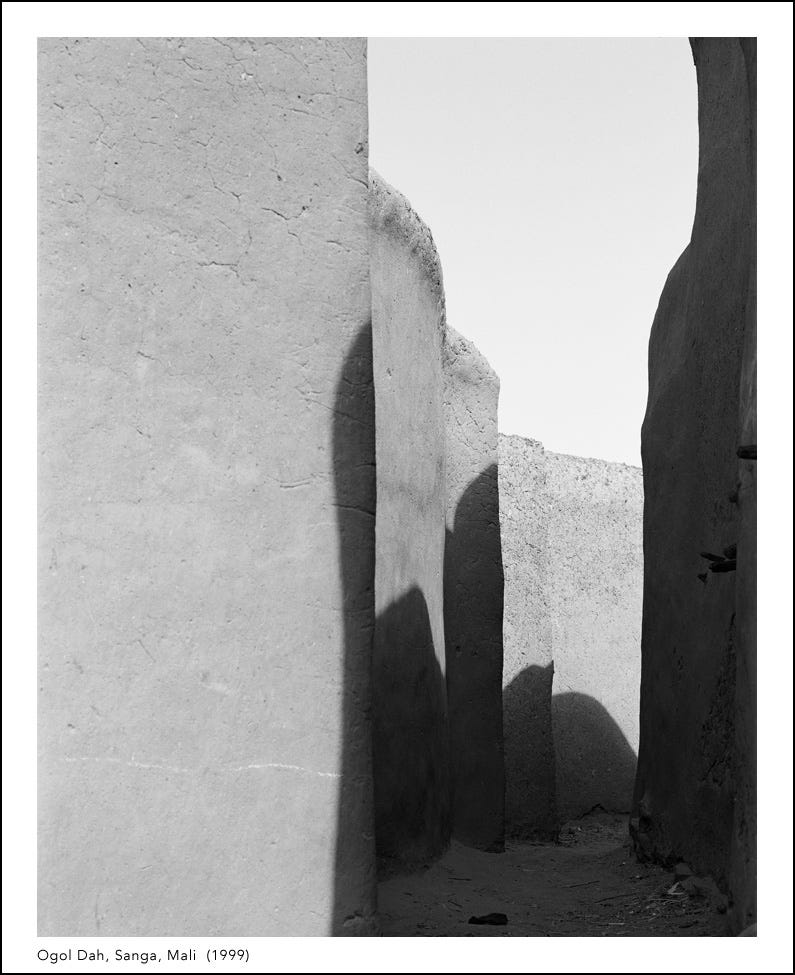
In 2003, my book Butabu: adobe architecture in West Africa was published with an extensive essay by the US academic, Susanne Preston Blier. It sold out in three years. Over its first decade there were eight solo exhibitions in the US and a similar number in the UK and Ireland. After 2017 works were incorporated in a series of museum shows at the Institute de Monde Arab in Paris, in Rabat Morocco, Maxxi Rome, the Sahel exhibition at the Met in New York, the Venice architecture biennale 2023 and the Art Biennale Riyadh 2024.
During the Venice biennale I met with its curator Lesley Lokko, founder of the Africa Futures Institute, who had commissioned five large prints for the Laboratory of the Future exhibition in the Arsenale. We started a conversation about the validity of bringing Butabu back into print for a new generation and a wider audience. But, by necessity, Butabu with a difference, and particularly incorporating African perspectives.
Lesley distilled our thoughts in the following way: In the years since Butabu was published much has changed - our understanding of climate, ecology, sustainability, heritage, and history has evolved. Interest in the future of Africa’s built and natural landscapes has grown. Architectural discourse has shifted dramatically from a Western and Eurocentric focus to embracing and exploring ‘other’ perspectives, notably from the global South. This re-framing and re-examination of what was once considered vernacular and traditional building techniques is a welcome addition to the rapidly expanding canon. A new generation of historians and theorists has emerged who straddle Africa and the global North simultaneously, offering critical insights into the relevance and importance of tradition in navigating and negotiating an increasingly complex present. She noted further that the foregrounding of African architects and scholars would be a marked departure from the anthropological framing through which such works have traditionally been viewed. “These new voices will offer an important critical lens for understanding the continent’s contributions to aesthetics, materiality, environmental stewardship and our diverse understanding of community.”
The idea had begun to take root.
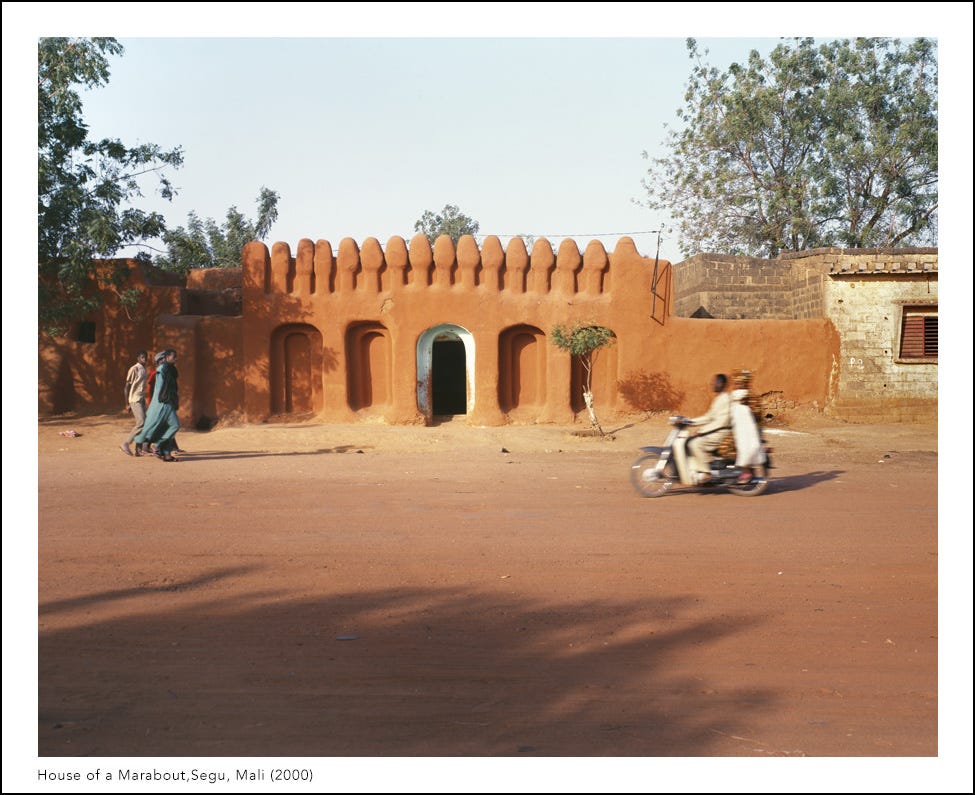
Over the last few years we have been working steadily to bring this project to fruition. I have been working my way through the archive, finding new and previously unpublished images, restoring and remastering some of the film damaged by heat while in the Sahel, making new prints of every image. We have been lucky to find a hugely supportive publisher in ArchiTangle in Berlin, who are rigorous in wanting to produce a well designed and beautifully printed book, helping to fulfil our ambition of a digital version of the publication for students particularly in the parts of Africa where paper books are hard to store due to climate.
Lesley has brought together established African architects Francis Kéré and David Adjaye along with younger writers Ewa Effion, Nana Biamah-Ofosu and Lois Innes. A year ago we were also confident that we had the funding in place that all visual books of this scale require to keep the sale price with in an workable limit - until that is Donald Trump entered the White House and US cultural support was cut stone dead. Thankfully Architangle has risen to the challenge and launched a Kickstarter campaign with the ambition of filling this funding gap and getting the book published in Spring 2026.
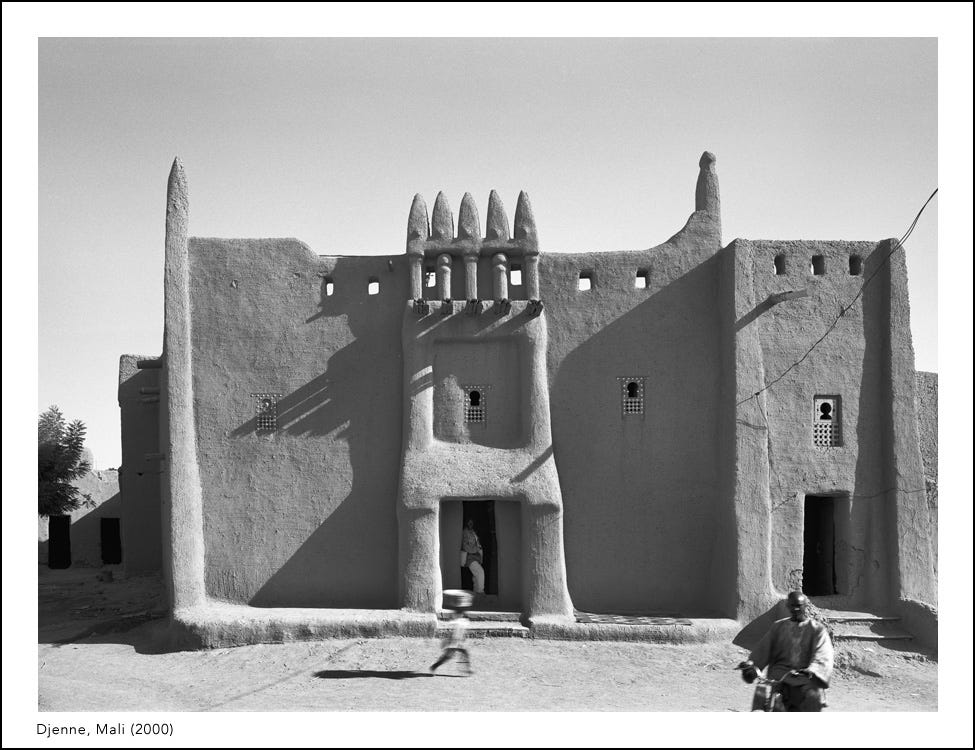
I am confident the book we make will be a fine thing to hold, more fulfilling than the first publication, correcting some of its inconsistencies; a book of finely reproduced photographs (between 250 and 300, we are editing still), many of them new, that doubles as a kind of archive and resource; and intercut with inspirational essays and writings providing essential contemporary scholarship and fresh insight.
Traditionally, in the villages of the Kassena from Burkina Faso and Ghana, when a person dies, their mud-built compound was left until required by a new generation, by which time it needed remaking. The aged building would be taken apart and the materials remixed with water and reconstructed by fresh hands. We took inspiration from this idea and called this new publication Butabu Remix.
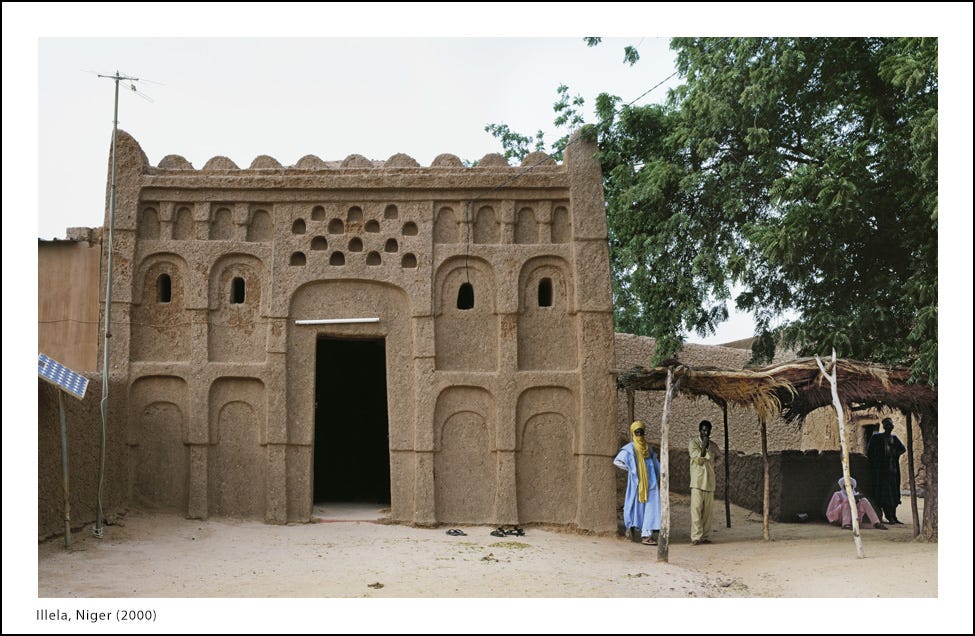
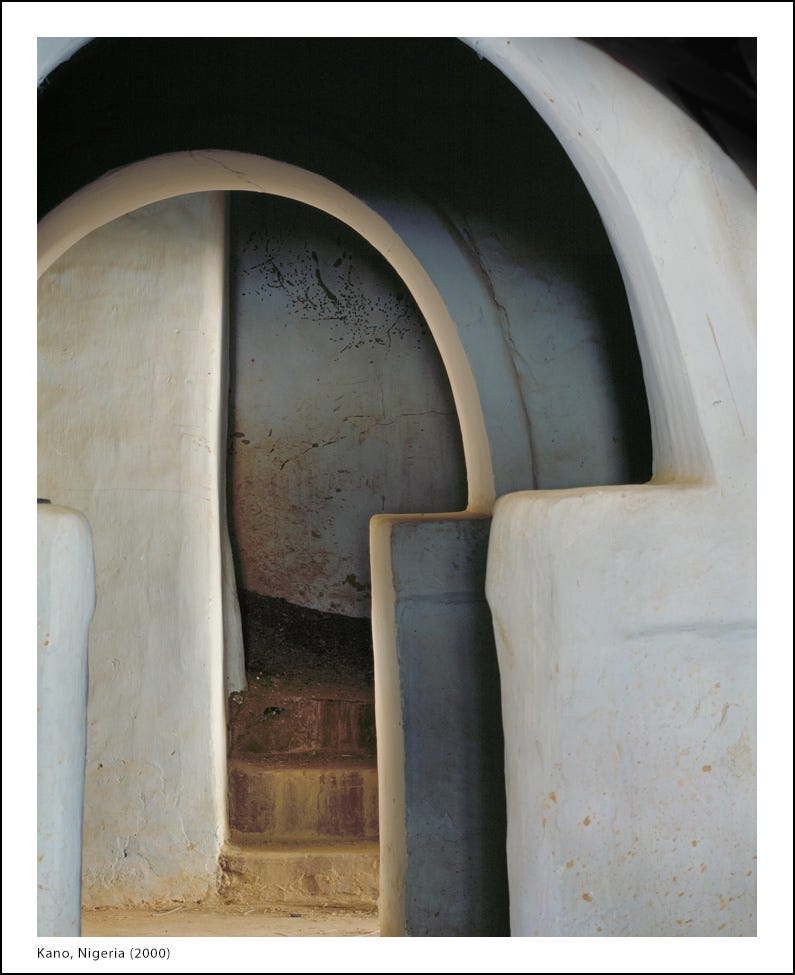
Please do take a look at the Kickstarter page and see if you can lend support, or pass it on if you know anyone else who might be interested. There is the option to make a donation or purchase discounted copies of the book in advance. Also to buy a set of postcards which, like the book, will be finely printed. A bit more expensive you can buy a copy of the book with a signed and numbered inlay archival print made in my studio. I really like prints this size, some people leave them in the book - when I buy collector inlaid editions from other artists I choose to mount, frame and live with them. The large prints in an edition of three each really are for hanging I think, and though considerably discounted do get quite a bit more expensive; but if we can attract buyers it will really help reach our target. I hope you enjoy looking.
James Morris, December, 2025
All images ©James Morris
What a good read. Living in East Africa we have the Maasai Bomas built in mud but I had never heard of the Butabu. Thanks for the sharing